



Note: This essay was written in approximately two hours, beginning at 11:43PM on Tuesday, September 1st. I got tired at 1:05am and decided to leave some parts of the essay unfinished, though I have decided to publish the initial draft anyways. I may never do this again, thought; I am experimenting with publishing the drafts of my essays, and then later editing them once the drafts are public. I expect this to reduce the cognitive demand of openly sharing my thoughts and will help facilitate more feedback. If you have thoughts, please reach out at hudson [at] papertlab [dot] org .
Axioms of Thought
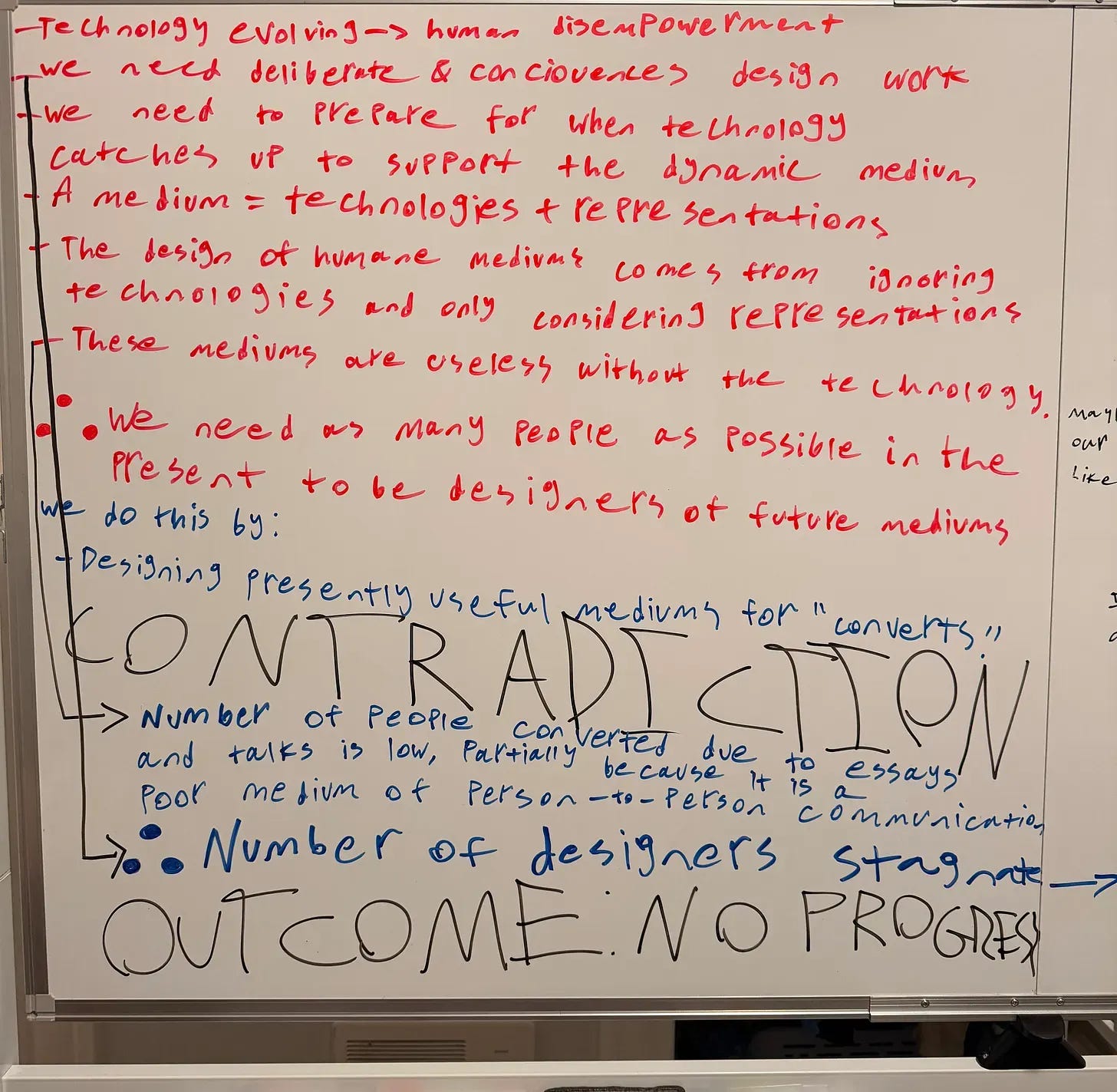
Technological Evolution Leads to Disempowerment
The evolution of technology has led to the increase of certain human capabilities but has generally lead to relative human disempowerment. For example, as hunter-gatherers we were able to think freely using many different representations that are now seldom used due to our sedentary lifestyle imposed by the printing press and computer--we gained an intuitive sense for physics by experimenting with different tensions of the draw string and angles of pointing the bow when shooting a bow and arrow, tracing different trajectories of projectiles in the dirt with sticks, and deriving spoken and written words like “point the bow at the farthest tree” or, later on, “angle the bow at 30 degrees upwards.” Now, while we can more easily hunt prey with the advent of gunpowder and the gun, we loose many of these knowledge representations, such as learning about tension through kinesthetically operating a bow and arrow. A more obvious example is the transition of writing from a pen and paper onto a computer screen that’s controlled by a mouse and keyboard. While we are now able to write things more quickly, we have lost the tactile advantages of manipulating a pen to communicate ideas. There are numerous other examples of this, and generative AI will certainly, even more than it already has, facilitate this duality of increased human ability matched with decreased human power and agency.
Deliberate and Conscientious Design Work
The necessarily bad remedy to this problem is to halt all technological progress, ban any further construction of data centers, and to all revert to being hunter gatherers and cannibals. I suppose this isn’t so bad, I mean chimpanzees seem to being doing just fine despite being both hunter gatherers and cannibals.1 So maybe this whole story of progress is all made up; I’ll leave that question to the philosophers and anthropologists. But let’s assume that human conatus2 is innate and an independent variable. Then, now what? Well, if humans will forever continue to improve upon our technology, how can we break the default of technology leading to further inhumane and disempowering mediums? Well, perhaps the solution is to mute the world and build your own.3 In the context of building humane, dynamic mediums that support the full spectrum of possible human representations of thought and knowledge, Bret Victor argues for deliberate and conscientious design work. Some mediums that support this kind of work are whiteboards, notebooks, computers, Figma, Claude Design, computational simulations, and physical models or objects. Note, Dyanmicland nor Realtalk came to mind (if they did for you, shoot me an email - we should be friends!), despite it probably being a more empowering and epistemically productive medium for design than Figma or Claude. This is because these experimental mediums are entirely impractical with today’s technology and set of incentives, causing most of us to turn to more accessible, albeit less empowering, epistemic (or not) mediums.
Preparing for the Future by Muting the Present
Since it has been true that following the advances of technology leads to disempowerment and that we need to design future mediums that support the full spectrum of epistemic representations, the obvious thing to do is to prepare for a future when the technology supports the satiation of these epistemic representations by conducting abstract research and creation amongst a small cohort of fellow idealists. The claim is that the best way to support the creation of a future humane medium is by conceptualizing what the design of such mediums might looks like in terms of the representations that they address.
What is a Medium?
I claim that a medium is comprised of the representations that it appeals to as well as the technology that it is built upon. This technology may be digital, like a computer, but it may also be analog, like a wheel.
Ignore Technologies, Only Consider Representations
By ignoring the current state of technological advances and only focusing on how we can design a medium that supports all representations of thought and knowledge, we may be able to conceptualize some medium that is entirely humane, at least in the abstract.
Mediums Without Technology Are Useless
For example, the conceptualization of movies and cinema had not material impact of human cognition or how we live until the development of the video camera and projectors.
Engineers are Plentiful, Designers are Scarce
Due to the importance of design in the conceptualization of future humane mediums, we need as many deliberate and conscientious designers focused on this problem as possible. Specifically, these designers need to mute current technologies and instead focus on conceptualizations of future mediums.
Designers are Supported Through Mediums
The best way to support designers and convert more people to becoming designers is by giving them mediums that support design work.
Contradiction
We need mediums that support designers, but we are only focused on the design and conceptualization of future mediums with non-existent technology. Thus, the only tool we can rely on to convert people to design is writing and rhetoric, which is not all that powerful compared to money, power, ego, productivity, fulfillment, etc. etc. Therefore, what ends up happening is the number of designers stagnates, the few people who care about a humane medium die, and no progress is made. Because of this, the most powerful thing we can do to support the creation of future humane mediums is by designing mediums based on existing technologies that support and extend epistemic representations that will support possible designers who are alive today.
Thanks to conversations with Andy Matuschak, David Barron, Austin Chen, Tyler Cowen, David Smith, Annapurna Vadaparty, Mary Shaw, and Ken Koedinger for helping to shape the thoughts present in this essay. Thanks to Bret Victor for giving this talk in 2014.
Conatus, noun — an innate, instinctive drive in every entity to persist, persevere, and enhance its own existence.
